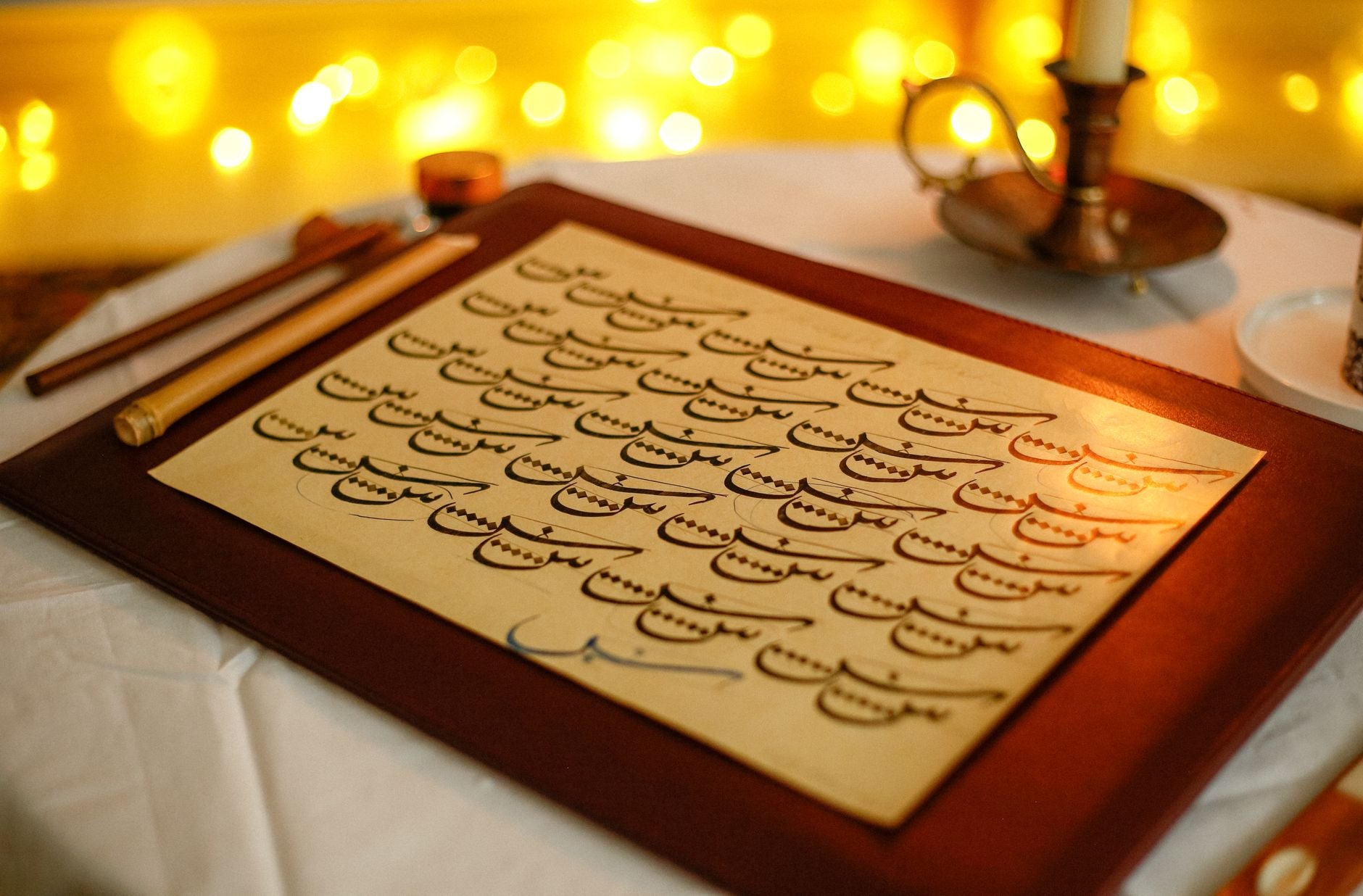
Djinn, in the classical Islamic-esoteric tradition, are not Hollywood spirits-in-bottles and not folk monsters. They are a real class of beings the texts describe as created from a different substance than humans, occupying the same world but at a different layer of it, with their own societies, their own intentions, and a documented pattern of interaction with the human field. Most of what circulates online is folk inflation. Most of what the operative tradition actually says is sober, structural, and useful to a practitioner who needs to understand the layer of reality they are working at. This guide is the textual account.
The Short Answer
Classical Arabic sources describe djinn as a created class of beings, distinct from angels and from humans, made of a subtle fire-like substance, possessing free will, organized into communities, capable of belief or disbelief, mortal but long-lived, and present in the same world humans occupy without being normally visible to ordinary sight. The Qur'an names them, hadith and the broader exegetical literature catalog them, and the medieval esoteric corpus — the science the tradition calls the letter sciences and its related disciplines — built a structured framework for understanding their nature and the conditions under which the human field interacts with theirs. The tradition is operationally cautious, ethically explicit, and very far from the folk superstition that surrounds the subject in popular media.
What the Classical Texts Actually Say
The Qur'an dedicates an entire chapter (Surah al-Jinn, 72) to the subject and references djinn across many other passages. The two foundational claims that recur are these: djinn are a created class separate from both angels and humans, and they were created from a substance the tradition describes as smokeless fire — meaning a finer, less dense form of matter than the clay-substance of human bodies. The texts treat them as moral agents: they can believe or disbelieve, act justly or unjustly, and are accountable for their conduct. They are described as long-lived but not immortal.
The hadith literature, the exegetical works, and the medieval esoteric corpus extend the picture. Djinn are described as organized into communities — tribes, lineages, regional concentrations — with their own languages, customs, and internal social structures. They are reported as capable of perceiving humans while remaining unperceived themselves, capable of physical action in the world under specific conditions, capable of long-distance movement at speeds humans cannot match, and capable of taking on forms that humans can see when they choose to.
The point of the textual account is not myth. The texts describe a class of beings with consistent properties. A practitioner who works with the tradition treats those properties the way a chemist treats the periodic table — as a description of what is actually there, with operational consequences for whoever interacts with it.
The Categories the Tradition Distinguishes
Within the broad category of djinn the classical sources draw further distinctions that matter for practice. The tradition uses several terms that are sometimes treated as overlapping subsets and sometimes as separate classes. Without getting into the philological debates, the working catalog a practitioner carries looks roughly like this:
- Believing and observant djinn — those described in Surah al-Jinn itself as having recognized the Qur'an as truth and aligning their lives accordingly. The tradition treats these as morally upright, generally non-interfering, and often beneficial when contact occurs lawfully.
- Indifferent or merely-coexisting djinn — the large quiet middle. They occupy their layer of the world, conduct their own lives, and rarely intersect human affairs unless humans intrude into their spaces. Most encounters happen because a human has crossed a boundary, not because a djinn went looking for trouble.
- Disobedient or malevolent djinn — the class the tradition is operationally cautious about. These are the ones who interfere with humans deliberately, who participate in what the obsession-and-possession case literature describes, and who must be addressed with the protective and corrective protocols the tradition has refined over centuries. They are a minority of the total population but the source of nearly all the practitioner-grade cases.
- The category of Iblis — in the textual account, the being who refused the angelic command and from whom an entire lineage of opposition descends. The tradition treats this lineage as its own taxonomic problem, distinct from the broader djinn classification.

Their Relationship to Humans
The classical position on the human-djinn interface is precise. The two communities share the same physical world but live at different densities of substance, like air and water occupying the same room without normally mixing. Most humans never knowingly encounter a djinn in their lifetime, just as most people never knowingly encounter a class of phenomena they have no instrument tuned to detect. The interface opens under specific conditions: in certain places (the tradition catalogs unkept ruins, certain natural features, neglected thresholds), at certain times (the hours described in the tradition as low-light, transitional), under certain human states (illness, severe emotional dysregulation, prolonged spiritual fasting, deliberate practice), and in response to certain human actions (oath-breaking, persistent injustice, calling on what should not be called on).
When the interface opens, the effects on the human field range from the harmless (a fleeting sense of being noticed) to the disruptive (what the case literature on obsession describes) to the severe (the smaller subset that classical operations are designed to address). My fieldwork — over ten years of cases — consistently confirms the textual account's structural claims about when and how the interface opens, even where modern medicine has no language for the phenomenon.
The Practitioner's Position
The operative tradition is the inheritor of a long, carefully-developed set of protocols for the cases where the interface has opened in a harmful way and a human is being affected. The relevant disciplines — the protective practices documented in the classical grimoires of the Islamic esoteric world — were refined over centuries by practitioners who treated each case as data and logged what worked. The result is a corpus of procedures with high reliability when applied correctly by someone trained to apply them.
The practitioner's position is also explicitly ethical. The tradition forbids coercive interaction with djinn for personal gain. It treats unlawful summoning — commanding a djinn to deliver an outcome, harming a third party through djinn intermediation, binding djinn into service against their will — as forbidden, dangerous, and self-defeating. The legitimate practitioner's work is protective and corrective: restoring a human field that has been disrupted, sealing what should be sealed, and releasing what should be released. This is the lawful frame inside which classical operations are conducted.

What This Tradition Is Not
It is not Hollywood. It is not the wish-granting genie of children's cartoons, and it is not the horror-movie tropes layered on top of vague folklore. It is also not the village-level folk superstition that overlays the actual textual tradition in many places — the inherited fear without the inherited framework. Folk superstition produces panic and reaches for the wrong remedies; the operative tradition produces clear procedure and reaches for the right ones.
It is also not anti-scientific. The tradition does not deny what medicine and psychology can address. It teaches the practitioner to triage: medical evaluation first when the symptoms have a medical explanation, psychological evaluation second when the pattern fits, and the spiritual frame third when the first two have been adequately ruled out and the case still has the structural signatures the textual tradition associates with the interface. This triage is not a concession to modernity; it is what the better classical authorities have always counselled. The tradition is rigorous because the work is consequential. For the wider esoteric framework that organizes this and other layers of practice, see how the Hermetic principles apply across these layers and the chapter on Correspondence.
What a Reader Should Take Away
If this is the first time you have read a sober, textually-grounded account of djinn in the Islamic-esoteric tradition, the takeaway is this. There is a class of beings the tradition describes consistently across many centuries and many sources. The description has internal structure, ethical weight, and practical consequence. Most encounters that humans interpret as djinn-related have other explanations. Some encounters do not, and for those the tradition has a protocol that is operative, conservative, and effective when handled by someone trained in it. The right relationship for most readers is not contact-seeking; it is informed coexistence and the basic protective practices the tradition makes available to everyone. The deeper material is for the smaller number of cases where it is genuinely needed.
Frequently Asked Questions
Are djinn the same as demons in the Christian sense?
No, not the same. They overlap conceptually in the "disobedient lineage" category but the classical Islamic tradition treats djinn as a created class with their own communities, including believing and observant ones, whereas the Christian theological category of demon refers specifically to fallen angelic beings. The categories are related but not identical.
Can humans see djinn?
Ordinarily, no. The tradition describes djinn as perceiving humans while remaining unperceived. There are documented exceptions — cases of taking-on-a-form, cases where the human is in a particular state of sensitivity — but the default is non-visibility. Reported "sightings" are sometimes legitimate, often misperception of natural phenomena, and not the everyday baseline.
How does the tradition diagnose djinn involvement in a human case?
By a structured pattern of signs rather than any single symptom. The case literature describes specific phenomenological signatures, response patterns to particular interventions, and contextual factors that distinguish djinn-related disruption from medical, psychiatric, or purely psychological etiologies. A trained practitioner triages medical and psychological first; the spiritual frame is the residual category, not the default.
Is working with djinn allowed in the tradition?
The protective and corrective work is allowed and is the principal lawful use. Coercive summoning, harm-directed work, and binding for personal advantage are not allowed in the tradition's ethical framework and are explicitly warned against by the classical authorities. The legitimate frame is restoration of the human field, not commanding of any other being.
What should an ordinary person do about djinn-related concerns?
Follow the basic protective practices the broader tradition makes available, maintain a consistent morning practice and evening review, do not pursue contact, and seek a trained practitioner only when an actual pattern of disruption emerges that meets the structural signatures the tradition describes. The right posture is informed and calm, not preoccupied or fearful.
About the Author
Hydas is a spiritual practitioner with over ten years of fieldwork in consciousness, esotericism, and occultism. Born into spirituality and trained from childhood, he has worked with 250+ counselling clients and 250+ obsession and possession cases, and has documented over 10,000 entities across his case record. He is the author of the HSTF (Hydas Synthetic Triad Framework) doctrine, which structures Hydas's operational approach to spiritual practice. He writes the operational version of practices most schools deliver in soft form.